
Speakers - 2026

Title: Stroke Mimicking as Parakinesia Brachitis Oscitans “Clock that triggers Limb Elevation”
Abstract
The rare phenomenon of abnormal involuntary movement of paralyzed upper limb in association with yawning following stroke was termed as parakinesia brachialis oscitans (PBO) by Walusinski et al. Only few cases have been described in the literature and there are many unanswered question of this clinical condition. We report a case of 66 year old female who presented with left upper and lower limb weakness , with involuntary dance like movements of left upper and left lower limb, with slurring of speech , with parakinesias (another action) in form of twisting, elevating left upper limb while walking, yawning. MRI brain showed acute infarct in Right Putamen, right posterior limb of internal capsule, Patient was started on Dual antiplatelets, and Statins along with physiotherapy.
Case Report- 66-year-old female non diabetic, non hypertensive, presented with chief complaints of sudden left upper and left lower limb weakness since 10 days, with choreiform movements of left upper and left lower limb(Predominant), with parakinesias (another action), in form of twisting , elevating left upper limb while walking , yawning, adjusting her dhoti to suppress these involuntary nmovements CNS examination revealed- Power of 5/5 in both upper limb, 4/5 in left lower limb at hip , knee , ankle, with deep tendon reflexes diminished(1+), cerebellar examination suggestive of impaired tandem walking. Patient was outside started on tetrabenazine, and Dual antiplatelet and Statins, MRI brain done outside showed acute infarct in right caudate lobe , right posterior limb of internal capsule, with MR angiogram showing Right ICA stenosis of around 60-70%. ( Fig B-E) .
Discussion- Cases of movement of paralysed arm in hemiplegic limbs which were completely disobedient to the will was known for a long. However, Walusinski et al. in 2010 proposed the term parakinesia brachialis oscitans (PBO) for this rare phenomenon. The term parakinesia, as defined “an abnormal involuntary movement that acts as a parasite, caricature or replacement of a normal movement” and oscitans means “yawn” in Latin
These involuntary, patterned movements usually include abduction and internal rotation of shoulder, flexion of elbow and extension of fingers. PBO has predilection for men, with Blin et al in 1993 reported similar case in France in a 62-year-old male individual with acute infarct in posterior limb of internal capsule similar to our case, with onset of symptoms few days after stroke, Similar case was reported in 49-year-old female, by Walusinski etal. in France in 2010) where territory of stroke was posterior limb of internal capsule, another case reported by Yung-Tsan Wu et al. (Taiwan – 2013) in 52 year old male where territory of stroke was in Right Putamen.
Pathophysiology (Fig A)- Walusinski et al proposed that dopamine and oxytocin trigger yawning mediated by paraventricular nucleus activation which tries to activate reticulospinal tract but normally supressed by motor cortex, In stroke patients this inhibition is lost , leading to activation of reticulospinal tract and activation of cervical motor neurons and limb elevation and other movements.
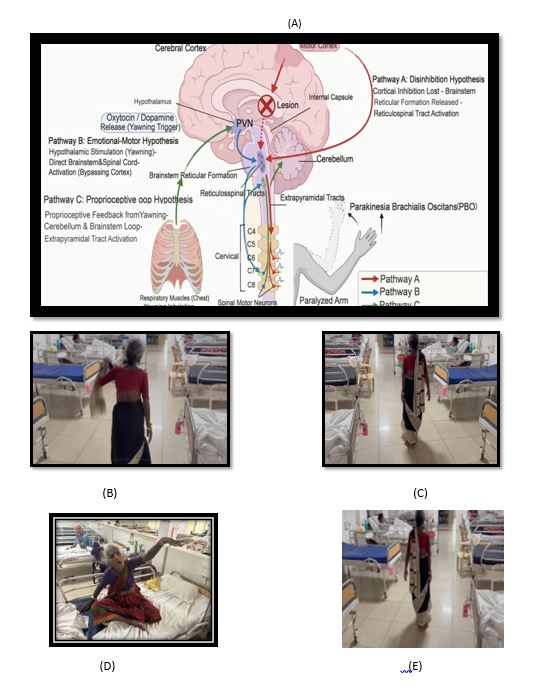
Fig-(A)- Pathophysiology of Parakinesia Brachitis Oscitans (B) Patient adjusting her clothes to supress involuntary movements(Choreiform) ( D ) Parakinesia Brachitis Oscitans (E) Patient on walking begin to raise her left upper limb while walking
Pearls of Wisdom-
- Parakinesia brachitis oscitans is a rare unique phenomenon, which occurs following stroke , triggered by yawn
- Clinicians should be aware of this transient phenomenon which should not be mistaken as a chronic movement disorder or focal epileptic seizures.
References-
1)Walusinski O, Quoirin E, Neau JP. La parakinésie brachiale oscitante Parakinesia brachialis oscitans. Rev Neurol (Paris). 2005;161(2):193-200.
2) Li J-Y, Wu L, Sun L-Q, Xiong J-M. Clinical and radiological characteristics of hemiplegic arm raising related to yawning in stroke patient. Med J Chin PLA. 2018;43(3):229-233.
Organizer

- 8 The Green, Suite R, Dover DE, 19901, United States
- +1 214 731 7766
- info@irisscientificgroup.com
Copyright © 2021 IRIS Scientific Group | All Rights Reserved Terms and Conditions | Privacy Policy